| Location: Main >
Optomechanics
> Translation Stages
|
| |
| Short and Long Travel Rack and Pinion Stages |
| P/N: | RPS Series |
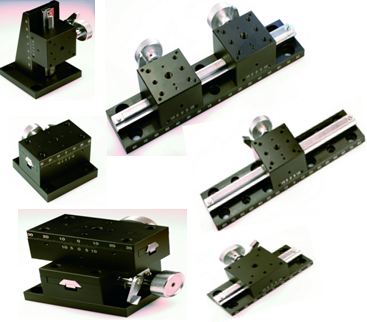
| Introduction: | The mechanisim of our precision rack and pinion stages features the basic components of a microscope tube focusing mechanism. The movement is precise and smooth. Hard steel construction with basement of hard aluminum structure, up to 154mm long travel distance offers cost effective solutions for many applications.
Stage can be locked in place for added vertical load capacity. A ruled scale and veriner permit a readout accuracy of 0.1mm. |
|
|
|
|
|
| |
| |
| Precision Double-Row Ball Bearing Linear Stages |
| P/N: | URM Series |
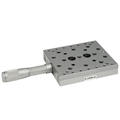
| Introduction: | Newport UMR Series Precision Double-Row Ball Bearing Linear Stages feature steel construction for high stability and rigidity. The ball bearings and precision-ground bearing surfaces provide exceptional linear travel, with angular deviation better than 100-200 µrad. UMR3, UMR5, and URM8 Series Stages have double-row ball bearings making them an excellent choice for carrying high loads. UMR12 Series Stages contain a single row of ball bearings. In all UMR stages, the moving carriage is preloaded by two springs to ensure constant micrometer contact for smooth, backlash-free motion. |
|
|
| P/N |
Keywords |
Unit Price |
Available |
Generate Quotation |
| PTUS1-TB-80-25/M |
94x80xT18mm;25mm travel;SS304,Center35mm;M4/M6 |
S$700.00/pc |
In stock |
Add to Request List |
| PTUS1-TEC-25-06 |
25x25xT12mm,6mm traval;Brass,Micrometer Center,M2 |
S$440.00/pc |
In stock |
Add to Request List |
| PTUS1-TSS-40-13 |
40x40xT19mm,Brass;13mm travel;Center Drive,M3 |
S$490.00/pc |
In stock |
Add to Request List |
| PTUS1-TSS-40-13-SI |
40x40xT19mm;Brass;13mm traval;Side micrometer;M3 |
S$495.00/pc |
In stock |
Add to Request List |
| URM8.25+BM17.25 |
92x80xT18mm,SS304,25mm-Travel,Center drive;M4/M6 |
S$580.00/pc |
In stock |
Add to Request List |
| PTUS1-MG-120-40/M |
120x120xT22mm,Brass;40mm-Traval;Dia56mm hole-thru |
S$2,100.00/set |
In stock |
Add to Request List |
|
|
| |
| |
| 1-Axis Translation Stages |
| P/N: | PTS1 Series |
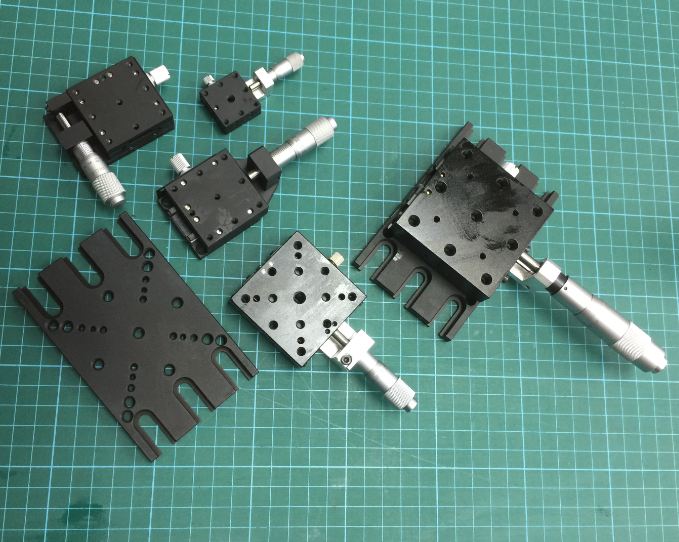
| Introduction: | A linear stage or translation stage is a component of a motion system used to restrict an object to a single axis of motion. The term linear slide is often used interchangeably with linear stage, though technically linear slide refers to a linear motion bearing, which is only a component of a linear stage. All linear stages consist of a platform and a base, joined by some form of guide or linear bearing in such a way that the platform is restricted to linear motion with respect to the base. In common usage, the term linear stage may or may not also include the mechanism by which the position of the platform is controlled relative to the base. |
|
|
|
|
|
| |
| |
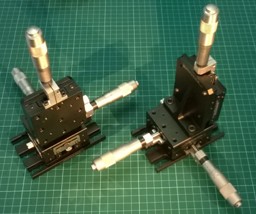
| 2-Axis XY Translation Stages |
| P/N: | PTS2 Series |
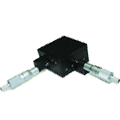
| Introduction: | For position control in more than one direction, multiple linear stages may be used together. A two-axis or X-Y stage can be assembled from two linear stages, one mounted to the platform of the other such that the axis of motion of the second stage is perpendicular to that of the first. A two-axis stage with which many people are familiar is a microscope stage, used to position a slide under a lens. |
|
|
| P/N |
Keywords |
Unit Price |
Available |
Generate Quotation |
| PTS2-6.5 |
XY Stage,Travel 6.5mm,Resolution 1um,M4 (x14) |
S$280.00/set |
In stock |
Add to Request List |
| PTS2-13 |
52x52xT20mm,XY,Travel 13mm,Center Drive Micrometer |
S$560.00/pc |
In stock |
Add to Request List |
| PTS2-25 |
65x65xT36mm,XY,Travel 25mm,Center Drive Micrometer |
S$720.00/pc |
Call us |
Add to Request List |
| PTS2-40-MG |
120x120xT44mm,XY Travel 40mm,DIA56mm hollow |
S$4,200.00/pc |
In stock |
Add to Request List |
|
|
| |
| |
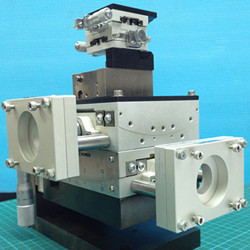
| 3-Axis XYZ Translation Stages |
| P/N: | PTS3 Series |
| Introduction: | A three-axis or X-Y-Z stage is composed of three linear stages mounted to each other (often with the use of an additional angle bracket) such that the axes of motion of all stages are orthogonal. Some two-axis and three-axis stages are integrated designs rather than being assembled from separate single-axis stages. Some multiple-axis stages also include rotary or tilt elements such as rotary stages or positioning goniometers. By combining linear and rotary elements in various ways, four-axis, five-axis, and six-axis stages are also possible. |
|
|
| P/N |
Keywords |
Unit Price |
Available |
Generate Quotation |
| PTS3-6T |
Miniaturized XYZ,Travel 6mm,25x25mm,Top-mount |
S$1,350.00/set |
In stock |
Add to Request List |
| PTS3-13T |
XYZ,Travel 13mm,40x40mm,Micrometer,Top-mount |
S$1,550.00/pc |
In stock |
Add to Request List |
| PST3-V13M |
XYZ stage,Travel 13mm,52x52mm,Vertical mount |
S$895.00/set |
In stock |
Add to Request List |
| PTS3-25M |
XYZ stage,Travel 25mm,Micrometer,Vertical 65x65mm |
S$1,100.00/set |
In stock |
Add to Request List |
|
|
| |
| |
| 5D Precise Calibration Plateform |
| P/N: | PCS5 Series |
| Introduction: | 5D Precise Calibration Plateform is made by full Stainless Steel, wth X Y Z translation stages and 2-axis Goniometer. It offers high precision adjustment and movement, designed for DVD optics calibration. |
|
|
|
|
|
| |




 Optical Substrates
 Optomechanics
 Solid Breadboards